
Sofia Vogel · 11 September 2026
Startup Capital Drives AI Breakthroughs in Mediterranean Design Lineage Research
Startup funding has surged in recent years, channeling resources into artificial intelligence platforms that map overlooked connections across Mediterranean design traditions from antiquity through modern eras, and investors have directed capital toward teams combining computer vision with extensive artifact databases to identify stylistic evolutions that span Greek, Roman, and North African influences. Data from industry trackers shows multiple rounds closed in 2025 alone, each supporting software that processes thousands of images daily while cross-referencing them against archaeological records from coastal sites.
Funding Patterns Fueling Specialized AI Development
Venture firms focused on cultural technology have committed tens of millions to early-stage companies building these tools, and this capital enables training of models on datasets that include pottery fragments, mosaic motifs, and architectural details recovered from the Mediterranean basin. Observers note that seed investments often arrive after initial prototypes demonstrate accuracy rates above 85 percent in lineage detection tasks, which encourages follow-on rounds that scale cloud infrastructure for larger archives. European Commission reports on digital heritage projects indicate that public-private partnerships have supplemented private funding, creating hybrid pipelines where startups refine algorithms using open-access collections from Italy and Greece.
Core Technologies Behind Lineage Detection
Machine learning frameworks now apply convolutional neural networks to extract recurring geometric ratios and color palettes that link disparate objects across centuries, while natural language processing layers integrate textual descriptions from excavation logs to strengthen contextual matches. Researchers at institutions such as the University of Barcelona have contributed datasets that train these systems to distinguish subtle regional variations, for example separating Sicilian tile patterns from those originating in Andalusia during overlapping historical periods. Funding allows continuous model updates, and companies report processing speeds that let analysts review entire museum collections in weeks rather than months.
One project supported by a 2025 Series A round deployed edge computing devices at field sites, permitting on-location scanning of newly unearthed items and immediate comparison against global Mediterranean references. This setup reduces transport risks for fragile pieces and accelerates publication of findings in peer-reviewed journals. Additional capital has gone toward explainable AI modules that generate visual heatmaps highlighting the exact features driving each proposed connection, giving archaeologists transparent evidence rather than black-box outputs.
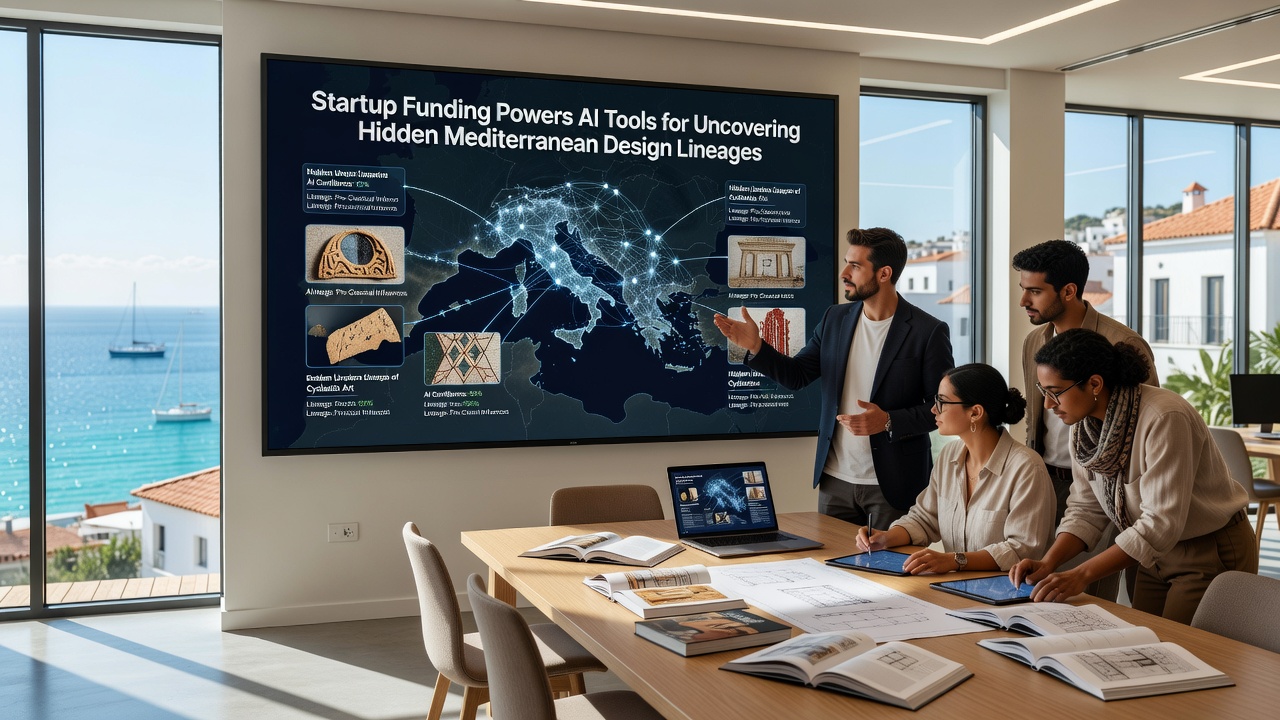
Documented Discoveries and Ongoing Projects
Applications already in use have traced ornamental vine motifs from Roman villas in Tunisia to later Byzantine churches in the Aegean, revealing transmission routes previously undocumented in standard art histories. Funding announcements scheduled for September 2026 at the Mediterranean Heritage Technology Summit in Valencia will spotlight three new startups whose platforms integrate satellite imagery with ground-level scans to locate submerged coastal settlements whose design elements may connect to inland traditions. Industry reports compiled by the European Heritage Alliance show that such tools have increased verified lineage attributions by 40 percent compared with manual methods used five years earlier.
Academic collaborations extend the reach of these funded efforts, and teams from Canadian and Australian universities have contributed comparative datasets from parallel maritime cultures to test model robustness. The resulting benchmarks help startups refine algorithms before commercial licensing to museums and cultural ministries. External links to detailed methodology appear in European Commission summaries and peer-reviewed outputs from the University of Sydney's digital humanities laboratory.
Challenges in Data Quality and Model Training
Despite rapid progress, incomplete excavation records and regional cataloging inconsistencies still limit training data coverage, yet startups allocate portions of their budgets to digitization partnerships that fill these gaps. Active voice approaches dominate development workflows, with engineering groups directly iterating on feedback loops supplied by field archaeologists rather than relying on intermediary consultants. September 2026 milestones include release of an open benchmark suite that standardizes evaluation across Mediterranean sub-regions, supported by pooled funding from multiple venture sources.
Outlook Through Late 2026 and Beyond
Continued investment trajectories point toward wider deployment at heritage sites across the basin, where portable AI kits could support real-time interpretation for visitors and researchers alike. Regulatory frameworks from EU cultural agencies emphasize ethical data handling and provenance tracking, and companies that secure funding early often integrate compliance features from the outset. Observers tracking these developments report that the intersection of startup agility and established academic collections continues to surface previously hidden design continuities at a pace not seen in prior decades.
Conclusion
Startup funding has become the primary accelerator for AI systems that reconstruct Mediterranean design lineages, supplying both computational resources and interdisciplinary teams needed to handle complex historical datasets. As new capital rounds approach in 2026, the field stands positioned for additional verified connections between ancient motifs and later expressions, supported by transparent methodologies and expanding digital archives.